
Lebanon
Tyre Coast Nature reserve
- Marine area 21% · 11,300 ha
- Land area 79% · 43,800 ha
Territory
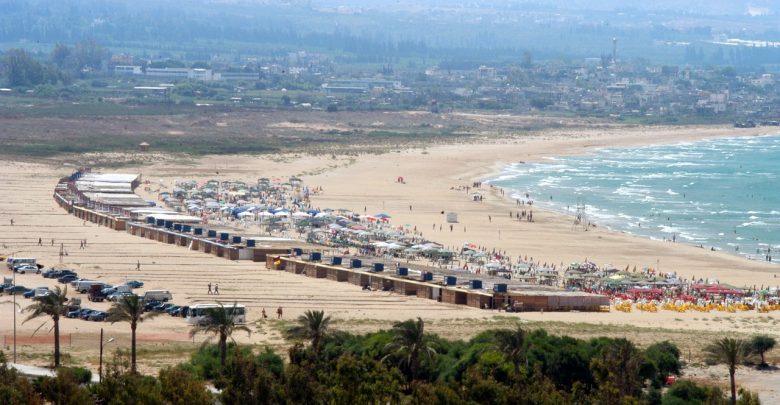
The Tyre Coast Reserve is formed of two parts, both along the beach of Tyre: the first part extends between Tyre city that is 80 km from Beirut city and Rachidieh to the south. The second part extends further to the south from Rashidyah to Ras Al Ain Pools. Rashidyah is a Palestinian refugee camp lying alongside the principal road to the beach.
Physical characteristic
The beach and the sand dunes of the Tyre Coast Nature Reserve are made up of a mixture of quartz and carbonate sands which are locally lithified to give beach rock. In places limestone gravels occur. The underlying geology is very significant as it controls the existence of the artesian springs. The main rock units are a sequence of porous and fissured Lower and Middle Cretaceous limestone which are overlain by a sequence of Late Cretaceous chalks and marls. The lower and middle Cretaceous limestone forms the aquifer that provides the majority of the region's water, although private wells tap the water of the upper Eocene sediments.
Specificity and importance
Tyre coasts nature reserve is an important nesting site for endangered Mediterranean Loggerhead and Green turtles. Actually, the reserve is characterized with sand beaches where these turtles breed and where migratory waders find their food away from hunters. There is also a unique community of sand dunes flora and its associated fauna, the last remaining dunes on the coast of Lebanon, and a wetland with non-halophyte plants on the coast and the beach.
Threats and Pressures
The users of the reserve are visitors from the immediate surroundings (local community) and others from all over Lebanon. The current human use and development is limited to conservation, recreation, agriculture, fishing, education and scientific research. The threats having pressure on the reserve are: Littering, stepping, digging and umbrellas fixing on the sandy beach of Tyre threatening the breeding habitat of both Green and Loggerhead turtles and contribute to the decline of these globally threatened species. Moreover, the current unsustainable agricultural practices may destroy the soil and kill non target species when pesticides are used.
Ecological characteristics
Twenty-one (21%) of the Tyre coasts flora is restricted to eastern Mediterranean. For ornithologists, many waterfowls and waders use the reserve as a stopover- an opportunity to see aquatic and semi-aquatic birds in a freshwater wetland near the sea, where also sea birds are seen passing along the shore. For botanists, the area encompasses one endemic species Astragalus berytheus and two rare and threatened species Ficus sycomorus and Pancratimum maritimum. For herpetologists, the sand dune reptile species and the amphibians of the marshes constitute a protected community that should be kept away from human disturbance. Moreover, the presence of two nesting marine turtle species is highlighted. The habitats of Tyre coasts nature reserve are mainly: sand dunes of Mediterranean coast, coastal freshwater land, sandy beaches, and pebble and stony beaches
Management
Lebanese Minestry of Environment, Nahed Msayleb, nmsayleb@gmail.com
Tyre coasts nature reserve has a five years Management Plan. This management Plan was prepared under MedWetCoast Project, which is an initiative under the Ramsar Convention. The national project was executed in Lebanon by the Ministry of Environment and managed by UNDP. The Management Plan was prepared as a part of different components that aim at conserving the biodiversity of global and regional importance in the Mediterranean basin. The Management Plan was developed in consultation with the local stakeholders, and was endorsed by the Ministry of Environment (MoE).
Geographical position
Tyre coast nature reserve is located in Southern Lebanon expanding over 380 ha, it remains the largest sandy beach in Lebanon.
Maps & photos
Managers
-
Nahed Msayleb
Documents
-
Download
Tyre Coast Nature reserve - Evaluation 2024
Evaluation reports Lebanon Tyre Coast Nature reserve 2024 291.77 KB
-
File not available
Presentation Report of Tyre Coast Nature reserve
Presentation reports Lebanon Tyre Coast Nature reserve 2012
Twinning
Twinned with Medes islands