
Italy
Punta Campanella
- Marine area 100% · 1,549 ha
- Land area 0% · 0 ha
Schéma ISEA

Territory
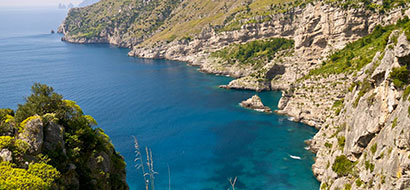
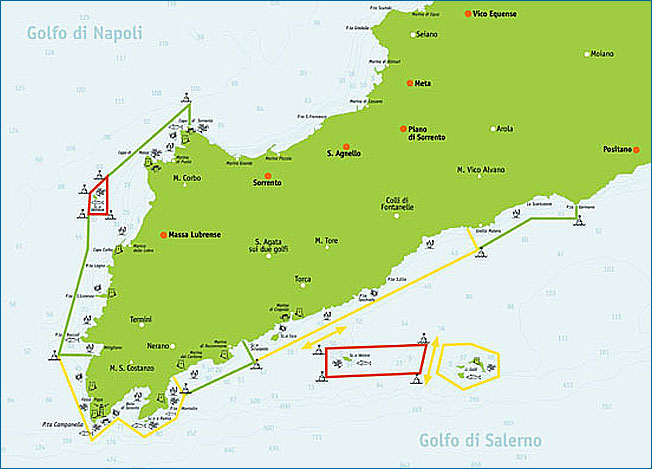
The reserve comprises the coastline that extends for 30 Km from Punta del Capo (Gulf of Naples) to Punta Germano (Gulf of Salerno) and includes a charming succession of grottoes, inlets and bays. A few miles off the coast, small reefs are scattered here and there (Vervece, Vetara, Isca and Li Galli).
Physical characteristic
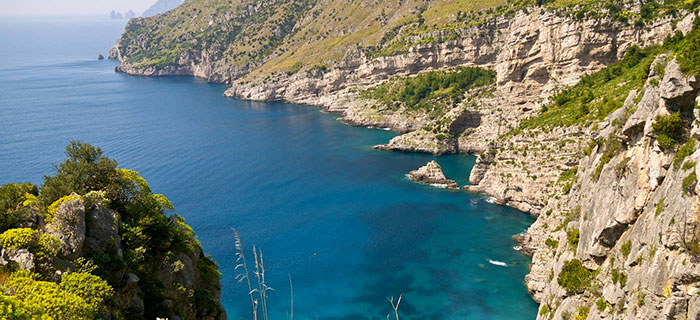
The area has a number of very specific environmental characteristics (geomorphological, hydrological and biogeographic). The coastal geomorphology of the Sorrento-Amalfi Peninsula is very different from the adjacent volcanic and alluvial parts of the Gulf of Naples and Salerno. In fact, it is characterized by steep limestone cliffs, advancing into the sea at a depth of more than 30-40 meters, where organogenic detritus bottoms extend to a vast muddy plain. There are also differences between the coast of Sorrento, overlooking the Gulf of Naples, and the coast of Amalfi, overlooking the Gulf of Salerno. The first is formed by lower cliffs (a few tens of meters) with relatively mild landscapes resulting from erosive phenomena. While the latter is characterized by very high and steep cliffs, gradually increasing in height from the distal to the proximal part of the peninsula.
Specificity and importance
The Punta Campanella MPA represents one of the richest areas of the Mediterranean Sea in underwater caves. Caves are an essential marine naturalist wealth because they are habitats with particular physical-chemical and biological characteristics. The underwater caves can accommodate a wide range, interesting and rare, of very singular animals (namely Halcampoides purpurea, Telmatactis forskali, Maasella edwardsi, Lysmata seticaudata, Plesionika narval, Oligopus ater). Species are very well suited to semi-darkness or total darkness, such as Stenopus spinosus and Plesionika narval.
Threats and Pressures
Tourism (more than 2.000.000 tourists in summer) is the main economic activity of the region, but organic farming of typical products (lemons, oil, vinegar) is also well developed. In the recent period, artisanal fishing activities have declined sharply while recreational fishing activities are increasing.
Ecological characteristics
The MPA is characterized by the dominant presence of a mass of nutrient-rich water, from the open and constantly brewed, generates a particular abundance of benthic communities (high biomass), with sessile organisms forming multilayer biological blankets on hard substrates. On these seabeds, one can cross, at all depths, a particularly strong diversity of species, also coming from different biogeographic characteristics. Depending on the particular animal or plant community, the typologies of the most curious marine biological communities can be summarized as follows: (1) biocenoses of hard bottoms, limestone cliffs and caves, (2) biocenoses of the bottom furniture, coarse sand and organogenic gravel, and (3) Posidonia oceanica meadows. Underwater caves can be considered as unusual and valuable laboratories for the study of life in atypical and extreme conditions. In caves, it is evident that the luminous intensity disappears rapidly; as a result, most living forms are of animal origin, and can be very diverse, particular and even rare.
Management
The Italian Ministry of the Environment and the Protection of Territory and the Sea (Ministry of Environment and Territory Management) is engaged in the management of the MPA through a consortium of 6 municipal districts (Massa Lubrense, Sorrento, Piano di Sorrento, Sant'Agnello, Positano and Vico Equense).
The aim of the MPA is to preserve one of the most beautiful facets of the Italian coastline, attractive to tourists and interesting on a naturalistic level for its terrestrial and marine characteristics. In fact, the MPA is both within a highly heterogeneous marine landscape and within a biogeographic convergence zone. The management of "Punta Campanella" aims in particular:
a) the protection of the environment of the entire marine area
b) the protection and improvement of the biological and geomorphological resources of the Area
c) the dissemination and disclosure of knowledge relating to the ecology and biology of the marine environment of the MPA
d) the development of educational programmes for the cultural improvement of ecology and marine biology
e) conducting scientific studies and programs on ecology, marine biology and environmental protection.
Geographical position
The MPA is located at the south-west end of the Sorrento Peninsula, part of the territory of the municipality of Massa Lubrense (Metropolitan City of Naples), in the Campania region of Italy.
Maps & photos
Managers
-
Antonino Miccio
www.puntacampanella.org
Documents
-
Download
Punta Campanella - Evaluation 2015
Evaluation reports Italy Punta Campanella 2015 2.92 MB
-
File not available
Presentation Report of Punta Campanella
Presentation reports Italy Punta Campanella 2009