
France
Port Cros National Park
- Marine area 30% · 1,380 ha
- Land area 70% · 3,220 ha
Territory
Région Provence Alpes Côte d’Azur, Département du Var (83)
Physical characteristic
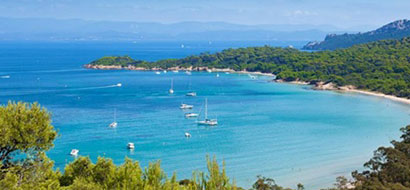
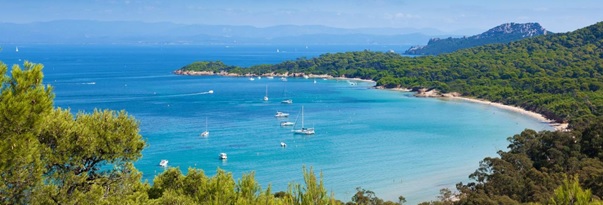
It is a remarkable site for its biological and landscape diversity due to islands architectural diversity. The ancient metamorphic rocks of gneiss and micaschists are the base foundation of the archipelago. Port-Cros island peaks at 196 m with steep cliffs overlooking the south coast. Only a few coves and three small beaches offer easy access to the sea. The main island, with its wild landscaped appearance, is covered by a highly developed scrubland dominated by Aleppo-pine trees, sometimes leaving room for a Holm-oak forest or coastal bush on the seaside. Some particular ecosystems are also present such as the beach dunes, temporary pools, some freshwater or brackish wetlands and a small dam in the center of the island. Lichens and fungi are very well represented.
Specificity and importance
With its 500 species of algae, 180 species of fish, the underwater domain offers a wide variety of landscape and two main ecosystems particularly rich namely the herbariums in Posidonia and the Coralligenous. The islands and islets are bathed in the current "liguro-provençal" bringing a planktonic richness with its procession of pelagic food chains. It is not uncommon to cross around these islands’ marine mammals, including the more coastal Great Dolphin. Six wrecks, 26 dry and falling listed in the waters of Porquerolles and Port-Cros, this archipelago is one of the best spots of diving in the Mediterranean.
Threats and Pressures
In Port-Cros, there is a village of about 50 permanent inhabitants, whose activity is linked to summer tourism, a hotel, five restaurants, a grocery store, a souvenir shop and a diving club. Only a professional fisherman practices his activity throughout the year. The managers of the national park lives on site and contribute, with their families, to the social life of Port-Cros.
The human pressure on this territory occurs essentially during summer. From Easter to All Saints' Day, shops are open to welcome visitors before and after the summer season. During the months of July and August, nearly 3,000 visitors arrive every day to discover exceptional landscapes punctuated by a line of great architectural and historical interest. Between tourists and divers, a total of 200,000 visitors per year are estimated, including about 8,000 pleasure boats, port and anchorage combined. Threats also come from invasive species such as the Caulerpa taxifolia or other invasive species.
Ecological characteristics
Species inventories include more than 1,500 animal and plant species in the park. The terrestrial animal population has some particularities like the Sardinian Discoglosse and the Phyllodactyle, respectively amphibian and small gecko endemic of Port-Cros, Corsica and Sardinia. Invertebrate and bat populations are also very contributing to richness in species diversity. Avifauna includes nesting species such as the Peregrine Falcon, Owls, the Mediterranean Shearwater, and the Common Warbler. The marine environment also offers a wide variety of landscapes and two main ecosystems particularly rich namely (1) Posidonia oceanica meadows which extends up to forty meters of depth, source of Mediterranean coastal biodiversity, and (2) the coralligenous that grows on rocks starting from twenty metres depth, made up of numerous invertebrates, such as the Gorgonians, Bryozoans and Sponges. The waters of the islands of the park also host exceptional fish populations and many rare species, such as consequent populations of dusky groupers and brown meagre, and other permanent or seasonal benthic species.
Management
Marine National Park of Port Cros (Marc Duncombe ; direction.pnpc@portcros-parcnational.fr )
(2017-2019), the main management axes are:
The monitoring the human activities associated with the marine environment, and consider, within the framework of the regulation of attendance and greater respect for the environment, to reserve access to the waters of the National Park for users observing appropriate behavior.
The effort of surveillance at sea, to be maintained for the application of laws and charters.
The development of indicators for monitoring habitat and emblematic species in the National Park
The development of an integrated land/sea approach through enhanced cooperation, articulation of tools and action solidarity between actors.
Geographical position
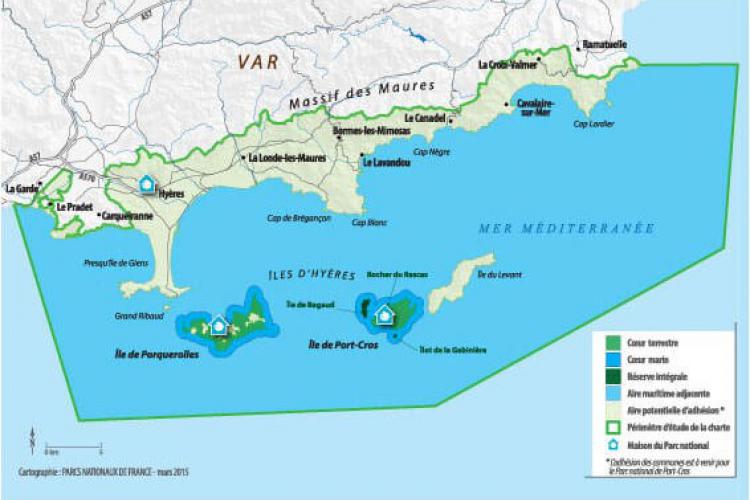
The national park of Port Cros is located in the south of France, in the department of Var, the commune of Hyères. The park includes the islands of Port Cros, Porquerolles, Bagaud, La Gabinière and the 600 m maritime band surrounding (up to 100 meters deep).
Maps & photos
Managers
-
Marc Duncombe
www.portcros-parcnational.fr