
France · Italy · Monaco
Pelagos Sanctuary
- Marine area 100% · 87,500 ha
- Land area 0% · 0 ha
Territory
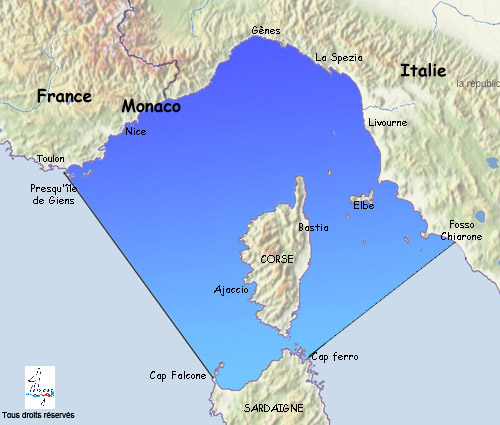
The Pelagos Sanctuary includes the coastal waters and the pelagic domain of the area between the promontory of the peninsula of Giens and the Fosso Chiarone in southern Tuscany. It includes the waters bordering many islands including Corsica and northern Sardinia, and smaller islands such as Hyères, Liguria, the Tuscan archipelago and the Bouches de Bonifacio.
Physical characteristic
It is a sanctuary located in the Corso-Liguro-Provençal basin, which stems from the finding, in the 1980s, that a relatively large and diversified population of marine mammals frequents this area, attracted by high primary productivity. A variety of fertilization mechanisms increase the level of primary production: coastal waters, delayed effect of winter mixing, frontal zone, upwelling phenomena and complex structures combining divergences and convergences. The bottoms of the Sanctuary were successively shaped by large folds and overlaps in the Alpine age, subsidence phenomena caused by Neogenic distensions, the morphogenesis of quaternary sea level oscillations, atmospheric, marine and river erosion, and recent and current sedimentation phenomena.
Specificity and importance
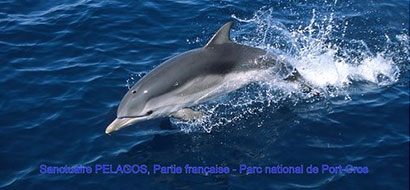
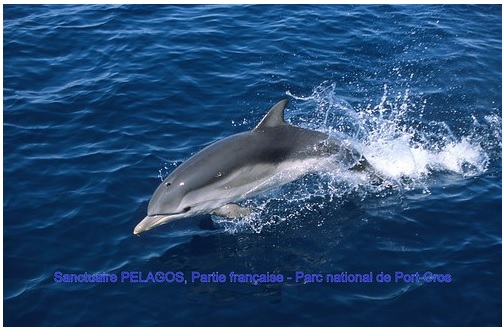
The marine mammals of the Mediterranean Sea, like all other marine mammals, have peculiarities in their way of life and habitat. Vulnerable and threatened species of marine mammals shall be included on the list of vulnerable or endangered species in Annex II to the SPA/BD Protocol, in particular: the common whale, the sperm whale, the black globicephal, the Great Dolphin, the Risso Dolphin, the Common Dolphin, the Blue and White Dolphin and the Monk Seal.
Threats and Pressures
In the sanctuary, several threats can arise:
- The urbanization and industrialization of the coastal zone inducing pollutant inputs but also by acoustic and seismic disturbances related to civil engineering works and the exploitation of the continental slope.
- International maritime traffic between the large islands and the continent generate risks of collision, direct disturbances and noise pollution.
- Recreational boating and cetacean sightseeing generate risks of direct disturbance to animals, together with the risk of collision.
- Fishing can generate an impact through bycatch and competition for food resources. Industrial fishing requires to be accompanied in this way.
- Climate change with increased sea water temperature and acidification could affect the presence and/or abundance of prey.
Ecological characteristics
The sanctuary is home to many of the different types of Mediterranean marine and coastal habitats. Numerous studies were carried out to define the habitat of cetaceans and to determine the presence of different species by the temperature of the surface water and the different water masses present, the depths and the topographic relief, hydrological phenomena such as upwellings. Preferred habitats based on observations would be the continental slope and the pelagic environment.
Management
Agreement Pelagos permanent secretary, Costanza Favili, costanzafavilli@pelagos-sanctuary.org
Since September 2004, the Pelagos Sanctuary management plan was performed and validated, to ensure an effective supervision of the area of competence of the Agreement in an objective of sustainability while increasing knowledge level about natural variables (environmental factors in the environment (light, hydrodynamics, hydrostatic pressure, temperature, salinity, benthic substrate, etc.), interactions between organisms, and all aspects of the structure and functioning of marine ecosystems), but also with the management of anthropogenic variables: input of polluting substances (urban and industrial chemical pollution), invasive species, overexploitation of ecosystems (socio-economic variable: fisheries, aquaculture, biodiversity use), coastal area management, commercial, recreational or sports boating, and water tourism.
Geographical position
Pelagos
Maps & photos
Managers
-

Costanza FAVILLI
Documents
-
Download
Pelagos Sanctuary - Evaluation 2024
Evaluation reports France, Italy, Monaco Pelagos Sanctuary 2024 280.26 KB
-
Download
Pelagos Sanctuary - Evaluation 2015
Evaluation reports France, Italy, Monaco Pelagos Sanctuary 2015 1.03 MB
-
Download
Presentation Report of Pelagos Sanctuary
Presentation reports France, Italy, Monaco Pelagos Sanctuary 2001 145.46 KB