
France
Les Calanques National Park
- Marine area 45% · 43,499 ha
- Land area 55% · 54,221 ha
Territory
Provence region Alpes Côte d'Azur, Bouches du Rhône department.
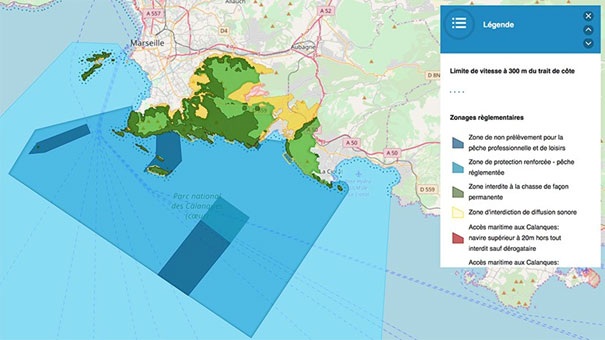
The marine territory of the Calanques National represents an area of 43,499 ha, up to a maximum distance of nearly 10 nautical miles from the coast. It includes also all the islands of the Riou archipelago and the “Ile Verte” off La Ciotat.
Physical characteristic
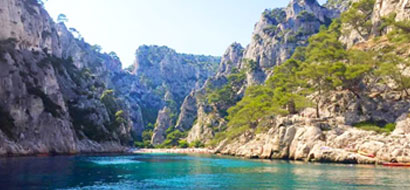
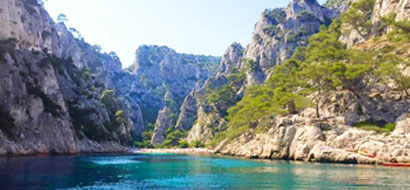
The park is composed of large limestone rocks forming deep and narrow valleys that continue in the water and hosts a very rich biodiversity. The limestone rock, an essential material of the Calanques massif between Marseille and Cassis, has formed deposits of sediments, fostering an intense underwater life. Tectonic movements and the action of wind, rain, ice, rivers, sea-level variations have carved majestic stone cathedrals, where cities have recently been settled. The territory is composed of several remarkable coherent landscape units: hills widely visible from the cities, cliffs close to the coasts, and small beaches between them (de la Gineste between Marseille and Cassis, de la route des Crêtes between Cassis and la Ciotat). It is a territory in the immediate neighborhood of the cities, with contrasting landscapes, tormented, where the maritime flatness disputes the high white or ochre cliffs and whose Calanques constitute the most singular characteristic. A landscape of islands, cliffs and hills visible from the cities they seem to be isolated from the outside world.
Specificity and importance
The outstanding interest of the terrestrial natural heritage is widely recognized by France (numerous ZNIEFF) and Europe (several Natura 2000 sites). The territory is a reference for the Mediterranean environments, presenting all the habitats from the coast to the edges. There are 30 remarkable habitats of Community interest, home to 138 nationally or regionally protected animal and plant species. The marine part also includes almost all the diversity of Mediterranean biocenoses, from deep canyons with cold-water corals, to Lithophyllum ridge near the surface. In addition to Posidonia meadows, a priority habitat, 14 biocenoses are of community interest, and more than 60 species considered as heritage, including the protected 2/3. The cultural heritage of the Calanques also reflects the long history of the Mediterranean coasts around Marseilles, are mixed with prehistoric remains of world level (cave Cosquer), ancient vestiges including many wrecks, military buildings and still little-known archaeological potential.
Threats and Pressures
Among the traditional activities, artisanal fishing is a fragile activity. It is the main professional activity of the territory, that still very dynamic despite the structural difficulties. However, the strong attractiveness of the coastlines generates important tourist flows (pressure exerted by anchorages, conflict of use etc.). Other pressures are due to the proximity of the park to Marseille such as the discharge of waste water, industrial waste etc. In addition, the demography of the municipalities close to the national park is generally increasing. The national park is therefore a protected area where many professional or recreational activities on land and at sea that are increasing. Attendancy is estimated at more than 1.5 million annual visitors generating environmental pressures and conflicts of use.
Ecological characteristics
The Calanques National Park is home to remarkable terrestrial and marine habitats and protected species. In addition, the first tens of meters underwater, accessible to humans and daylight offer remarkable landscapes by the diversity of geological reliefs, life fixed on the walls or moving nearby. According to recent inventories, 62 species of heritage interest were identified on the site. Two thirds of these species are protected by national law and/or international convention and about 1/3 are specific species for the PACA region, among them: the gorgons that structure the coralligenous landscape with sponges, (some are protected by the conventions of Berne and Barcelona), the red coral, the diadem sea urchin, the Mediterranean noble pen shell, , two species of seahorses (the spotted or long-snouted seahorse and the short-snouted seahorse), the brown meagre and the dusky grouper which are subject to a moratorium banning their fishing, the loggerhead turtle, cetaceans which are regularly observed in the marine space of the national park which constitutes one of the most important areas of concentration of these animals in the western Mediterranean, in particular the common whale, the great dolphin and the blue and white dolphin.
Management
Parc National des Calanques, François Bland, contact@calanques-parcnational.fr
The five major challenges described in the Charter for the management of the territory of the Calanques are: to consider the marine and terrestrial spaces as a single independent territory, to allow the good coexistence of human activities and the exceptional natural space, to include uses in sustainable development, to reduce the risk of fire, and, finally, to perpetuate in time a territory of quality.
Geographical position
The Calanques National Park is located in the south of France, in the department of the Bouches du Rhône.
Maps & photos
Managers
-
François Bland
www.calanques-parcnational.fr
Documents
-
Download
Presentation Report of Calanques
Presentation reports France Les Calanques National Park 2017 3.32 MB