
Cyprus
Lara-Toxeftra turtle reserve
- Marine area 85% · 550 ha
- Land area 15% · 100 ha
Territory
The Lara – Toxeftra area, located in the south-western part of the Akamas peninsula (Natura 2000 site), 15 km north of the town of Pafos extends inland to 90 meters from the sea (from the mean sea level) and extends seaward to the 20 meter isobath, which is about 0.4 to 1 km from the coast. Pafos, Cyprus.
Physical characteristic
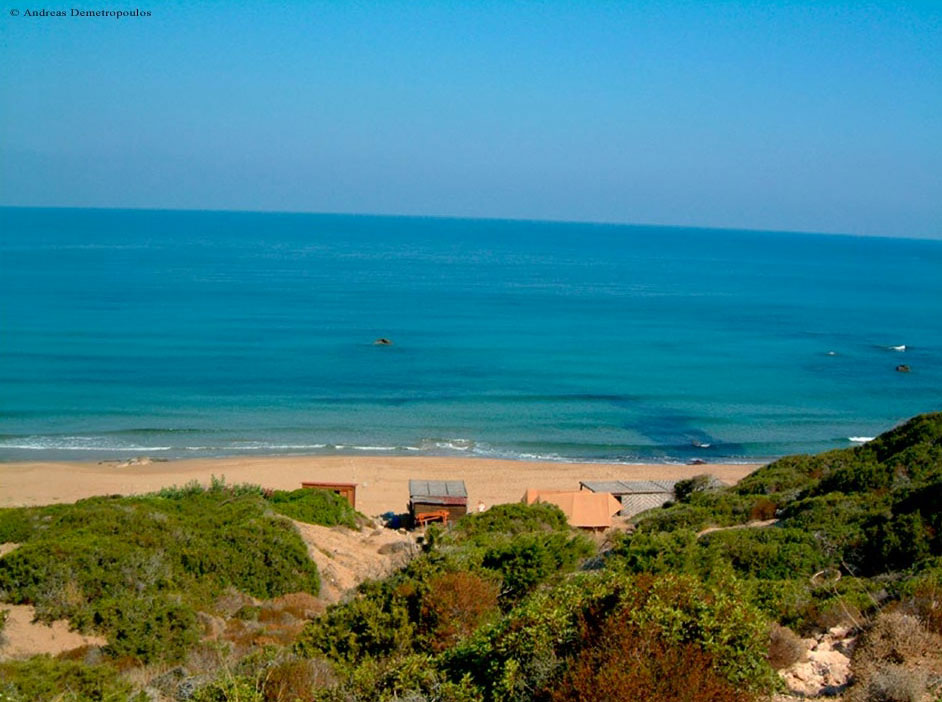
The turtle reserve has a series of sandy beaches alternating with rocky shores and shingle beaches. Some of the beaches have sand-dunes adjoining them. The sea bed in front of the protected beaches is mainly sandy, with extensive rocky substrates especially around the cliffs and capes. There are sea cliffs with cracks and small caves in the Lara area, in the limestone areas. There is little or no sedimentation or erosion. There are also 3 water sources and one freshwater spring (Avakas Gorge) giving a permanent flow.
Specificity and importance
The turtle conservation projects started in Lara- Toxeftra marine reserve since the year 1976, with beach surveys after the first turtle tracks were noticed. In 1978 the Lara Turtle Station was set up on the west coast of the island. The Project evolved with time from a primarily hatchery project, with some head-starting, to a much wider project involving habitat protection, which started in 1989 with the setting up of the Lara-Toxeftra Reserve. The beaches of the area are some of the few nesting areas of the remaining populations of the Green Turtle (Chelonia mydas) in the Mediterranean. The Loggerhead Turtle (Caretta caretta) also nests there. Monk seals Monachus monachus have been reported in the area (1988, 1989,1990,1991,1992, 2010, 2011, 2012). Ghost crabs (Ocypode cursor) inhabit some of the beaches in the area and are also protected.
Threats and Pressures
There are no human settlements within the area. The area is mainly used for fishing and leisure activities and ecotourism. Small-scale fishing (artisanal), sport fishing (on boat), spearfishing and rod and line fishing are the main fishing activities that are generally practiced in the protected area - and in the western part of the Akamas Peninsula. These activities are prohibited (with the exception of rod and line fishing) in the Lara-Toxeftra Reserve, during the turtle breeding period i.e., from the 1st June to the end of September.
Ecological characteristics
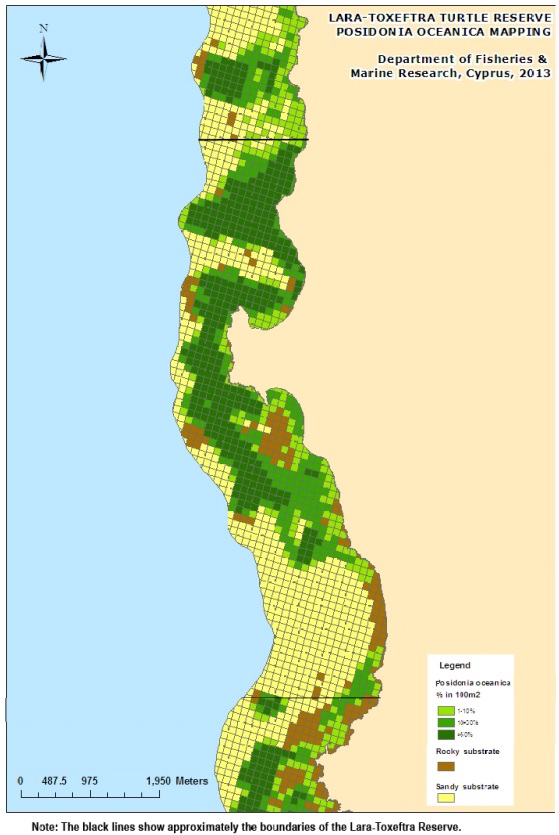
The turtle reserve is known for its undisturbed sandy beaches where Green turtle (Chelonia mydas) and Loggerhead (Caretta caretta) nesting occurs are critical to the survival of the two species - and to the survival of the Ghost crab. The marine part hides also Posidonia oceanica meadows covering 6.4 ha. Shallow meadows can be found in the protected area on big blocks, at depths as shallow as 1m depth.
The terrestrial vegetation of the protected area is to a large degree wind-shaven Maquis forest with Pistacia lentiscus (Lentisc), Juniperus phoenicea (Juniper), Olea europea (wild olive), Myrtus communis (Myrtle) and Ceratonia with Cistus monspeliensis. There are several species of Orchids (Orchis pyramidalis, O. coriophora ssp. fragnans, Serapias vomeracea etc.) as well as sand-dune vegetation, which includes the endangered Pancratimum maritimum. Endemic plants include Carlina pygmaea, Alyssum akamasicum and Gladiolus triphyllus.
The terrestrial fauna of the area is rich in diversity and includes the endemic Crocidura cypria (Cyprus White-toothed Shrew), as well as several species of bats. Foxes, hares and the Eastern Hedgehog (Hemiechimus auritus) live there also. There are several reptiles in the area including the Spiny-footed Lizard (Acanthodactylus schreiberi), Vipers (Vipera lebetina), Montpellier snakes (Malpolon monspessulanus), Agama Lizard (Agama stelio) and many others. There are also many species of butterflies including some endemic varieties and species.
Management
Department of Fisheries and Marine Research, (DFMR) - Ministry of Agriculture, Rural Development and Environment, Marina Argyrou, margyrou@dfmr.moa.gov.cy
The main objective is the protection of nesting sites of two species of marine turtles, Caretta caretta and Chelonia mydas witch are important resident populations. Moreover, the reserve was included in 2011 in the Natura 2000 network as part of the Akamas peninsula. The main activities are the management of the Lara-Toxeftra coastal and adjacent sea. This includes law enforcement. All beaches are monitored and all nests are protected in situ on all the beaches they were laid on. Non-magnetic, self releasing cages are used. Nests laid too near the sea are relocated up the same beach (about 5% of the nests). Nests from intensive tourism beaches, A rescue facility is run at the Meneou Experimental Mariculture Station.
The management regulations for this area that are spelled out in the Consolidated Fisheries Regulations (273/90), prohibit during the nesting season which is from the 1st of June up to the 30th of September, the entry and anchoring of a vessel of any kind in the protected area, down to the 20 m isobath, as is any kind of fishing (except with a rod and line from the shore). The presence of the public on the beaches from sunset to sunrise is prohibited as is the use of umbrellas and sunbeds on the beach. Camping and driving on the beaches are also prohibited.
Geographical position
The Lara-Toxeftra area, located in the south-western part of the Akamas peninsula, Pafos, Cyprus.
Maps & photos
Managers
-
Marina Argyrou
Documents
-
Download
Lara-Toxeftra turtle reserve - Evaluation 2024
Evaluation reports Cyprus Lara-Toxeftra turtle reserve 2024 249.92 KB
-
File not available
Presentation Report of Lara-Toxeftra turtle reserve
Presentation reports Cyprus Lara-Toxeftra turtle reserve 2013