
Albania
Karaburun Sazan National Park
- Marine area 100% · 12,570 ha
- Land area 0% · 0 ha
Schéma ISEA
Territory
The Vlora municipality, Vlora Region
Physical characteristic
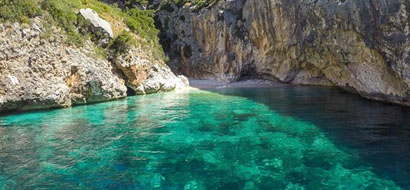
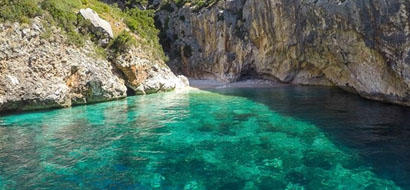
The slopes of Karaburuni Peninsula are locally very steep on the western side and culminating in the central part. The western coast of the Peninsula is incised by caves and deep canyons ending rarely by gravel or sand pocket beaches. It is characterized by high vertical cliffs that are quite eroded and numerous caves, mostly underwater, can be seen where freshwater springs often percolate. The most important canyons are at cape Pëllumbave and at Gryka e Ferrit. On the eastern side, the coastline is lower and is formed in the SW by slanted folds of limestone plunging into the sea. The area encompasses two geomorphological units, terrigen formations which can be heavily eroded (flysh, e.g. and quaternary deposits of molas) and carbonate rocks (limestone and limestone-dolomite, with rudists or globotruncana, of upper-Cretacea, e.g. karstic mountains of Rreza e Kanalit-Karaburuni). This area is certainly the best and most impressive part of Albanian coast for the development of nautical activities such as scuba diving, which is not well developed in Albania.
Specificity and importance
Karaburuni Peninsula is characterized by a very low level of disturbance. It is characterized by the presence of habitats and ecosystems that are endemic to the Mediterranean region, noticeably: Seagrass meadows (Posidonia oceanica (surface=1658 ha), Cymodocea nodosa, Zostera marina), Lithophyllum byssoides bioconstructions, Coralligenous community reaching an area of 296 h and Marine caves. It still hides several endangered or threatened species that are included in the Annex II of the Protocol SPA/BD, such as: the mussel date (Lithophaga lithophaga), the purple starfish (Ophidiaster ophidianus), the coralligenous algae Lithophyllum byssoides, the monk seal (Monachus monachus), the short-beaked common dolphin (Delphinus delphis), and the loggerhead turtle (Caretta caretta).
Threats and Pressures
The small beaches in the eastern coast of Karaburuni (Raguza, Shen Vasili, Shen Jani) are regularly frequented by tourists, including by excursion boats. Illegal fishing activities are also present in the rocky areas of both sides of Karaburuni Peninsula and sometimes in the western side of Sazani Island. Moreover, the most frequented activities, often associated with damages of habitats, are diving and spear fishing. The following threats have been also identified:
- Degradation of Posidonia meadows
- Degradation of coralligenous communities
- Decreased fish stocks and harvesting of marine invertebrates
- Degradation of geological formations
- Pollution
- Invasive species
Ecological characteristics
Marine habitat types identified in NMP Karaburun-Sazan until 2014 include Biocenosis of mediolittoral caves, Biocenosis of the Posidonia oceanica meadows, Coralligenous biocenosis, and Biocenosis of semi-dark caves.
The most important and sensitive species in the area Karaburuni Peninsula – Sazani Island are: the Red coral (Corallium rubrum), the mussel date (Lithophaga lithophaga), the dusky grouper (Epinephelus marginatus), the purple starfish (Ophidiaster ophidianus), the coralligenous algae Lithophyllum byssoides, Cystoseira communities, the monk seal (Monachus monachus), the short-beaked common dolphin (Delphinus delphis), and the loggerhead turtle (Caretta caretta). Moreover, this area hides some important crustaceans like the lobster (Homarus gammarus), the crawfish (Palinurus elephas), the greater locust lobster (Scyllarides latus), and the spiny spider crab (Maja squinado).
Management
Yes, (Lorela Lazaj, Nexhip Hysolakoj, Tatjana Mëhillaj, Administrata Rajonale e Zonave te Mbrojtura Vlore)
A management Committee of the Marine National Park Karaburun-Sazan was established in 2012. The committee is responsible for the management and protection of the area, including implementation of the management plan. Law enforcement is shared between several institutions including State Environment and Forest Inspectorate, Fishing Inspectorate, State and Border Police, etc.
The management plan for the National Marine Park Karaburun Sazan has been developed in 2014 by WWF and INCA with the financial support of UNDP/GEF. The Management Plan has been developed through participatory approach, including four stakeholder workshops, meetings, questionnaires, etc., taking into account opinions and needs of local communities, local and regional governments, as well as central government.
Geographical position
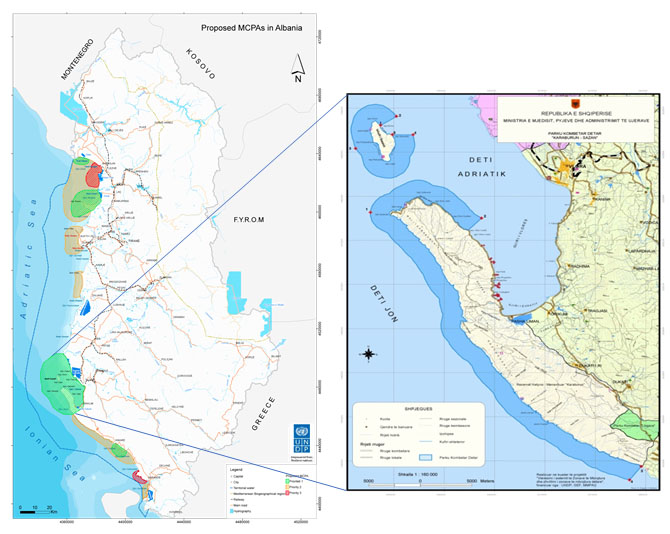
The National Marine Park “Karaburun Sazan” is located in southern Albania, on the north and western shore of the Karaburuni Peninsula and around the Sazani Island, at the southern end of Adriatic and northern border of the Ionian Sea.
Maps & photos
Managers
-
Lorela Lazaj
www.karaburunsazanmpa.com
Documents
-
Download
Karaburun Sazan National Park - Evaluation 2024
Evaluation reports Albania Karaburun Sazan National Park 2024 319.97 KB
Twinning
Twinned with Torre Guaceto